Do Nothing
tony g · May 1, 2026
The smartest people in the room aren't always the busiest. They're just the ones who figured out what actually moves the needle.
You've probably been told your whole life that more effort equals better results. Work harder, stay longer, optimise everything. Life hack yourself into oblivion.
There's a thing called "The Law of Requisite Variety" and the short version is this: a system can only stay stable if its internal complexity matches the complexity of its environment.
So let's explain it in football/soccer terms, if you are a goalkeeper (the system) you are up against the striker (the environment) and the environment can shoot the ball in any direction. If you can only dive and save to the right then that is your limitation. The solution is requisite variety, learn to dive in every direction.
Your mind works the same way. When your inner world is simpler than your outer world, life will overwhelm you. Every challenge is "too hard" because you are limited. When your mind becomes complex enough to meet reality, life starts bending around you instead of against you.
How do we build that complexity? You learn. Broadly, deeply, and consistently. And then, most critically, you stop and let it settle (this part is important).
The Productivity Myth
Perople will sell you on productivity and insist on doing more in less time. I don't blindly abide by this. Really, the highest-leverage thing you can do on most days is not do more, but rather think more or think better. I am quite the wordsmith.
Warren Buffett (apparently) reads for five hours a day. Not because he's avoiding work or being "unproductive" but because that is his work. His edge isn't access or effort or productivity for the sake of being productive. It's judgment, and judgment comes from having so many mental models that almost nothing surprises you anymore. The complexity of his inner world matches the complexity of the markets he navigates. That's why he moves through decisions with a near-annoying calm.
Those like Buffet, the rich or successful are usually just pigeon-holed. Some would say these people are just relentlessly busy and productive. Actually they just build their days like engineers. Keep long blocks for reading, thinking, and reflecting. Prioritising quiet time that looks, to the untrained eye, like laziness. Or boredom (I have a writing thing on this, you should read it).
What's actually happening underneath is intense information processing. Synthesising decades of data, compressing complexity into simplicity. That's where the leverage lives, not in the to-do list. We distract ourselves with endless tasks and reward ourselves with mindless media.
There is plenty of time in a day, you just need to start using it properly.
The Knowledge Economy
Everything about how value is created has changed. What used to require physical labour and long hours now rewards understanding, creativity, and mental flexibility. The global economy shifted from producing things to producing knowledge, and that shift made learning the new currency.
In the industrial age, the way to win was efficiency. Do the same thing better, faster, cheaper. Machines took that model and perfected it. So that particular game is no longer yours to play.
The most valuable skill you can have now is sensemaking. The ability to interpret complexity, identify patterns, and make good decisions when everything keeps changing. The people who think clearly will earn more, adapt quicker, and move faster than the people who just work hard. Always.
The most important challenge now is increasing the productivity of knowledge work, and with the amplification of LLMs and AI models, this is only accelerating. The responsibility has shifted from companies to individuals. Nobody is managing your growth anymore, you are your own system now.
Compounding Wisdom
This might sound depressing to some, because learning or education was seen as a process; learn to walk, go to school, study some more after, get a job. You're done. Consider yourself learned.
This won't work anymore.
Knowledge doesn't grow in a straight line. It is not a finite task. It multiplies. Each new idea connects with every idea you already know, forming a network that grows faster the more you feed it. A single principle from a book today seems small. Connect it with ten other ideas over the next year, and it becomes a framework that changes how you see everything.
The catch is that it starts slow. Almost invisible. Sometimes disheartening. You read, you study, you sit with ideas, and for a while you don't feel any smarter. That's just the accumulation phase. The deposits are small but steady, and they're compounding below the surface whether you notice it or not.
Then something shifts. What used to take weeks to understand starts clicking in hours. Connections form on their own. You start seeing patterns where other people see chaos. What outsiders call talent is just accumulated understanding in motion.
Designing the Day Around It
Some real talk. Truth is, wisdom doesn't compound in chaos. It compounds in rhythm.
Your energy moves in natural cycles, roughly ninety minutes of focus followed by a dip where the brain needs rest. If you structure your day around these cycles instead of against them, your output doubles without any extra effort. Work deeply for one full block, then stop. Walk, stretch, stare out the window. Don't fill the pause with distraction. The wandering is where insight lives.
The morning is your best window. Your brain wakes up hungry for novelty. Use that energy for learning first. Read slowly, take notes, sketch out a thought in your mind. Let one idea pull you toward the next. Then, in the afternoon, apply what you absorbed. Make decisions, create something, execute. Before you close out the day, spend five minutes reviewing what clicked.
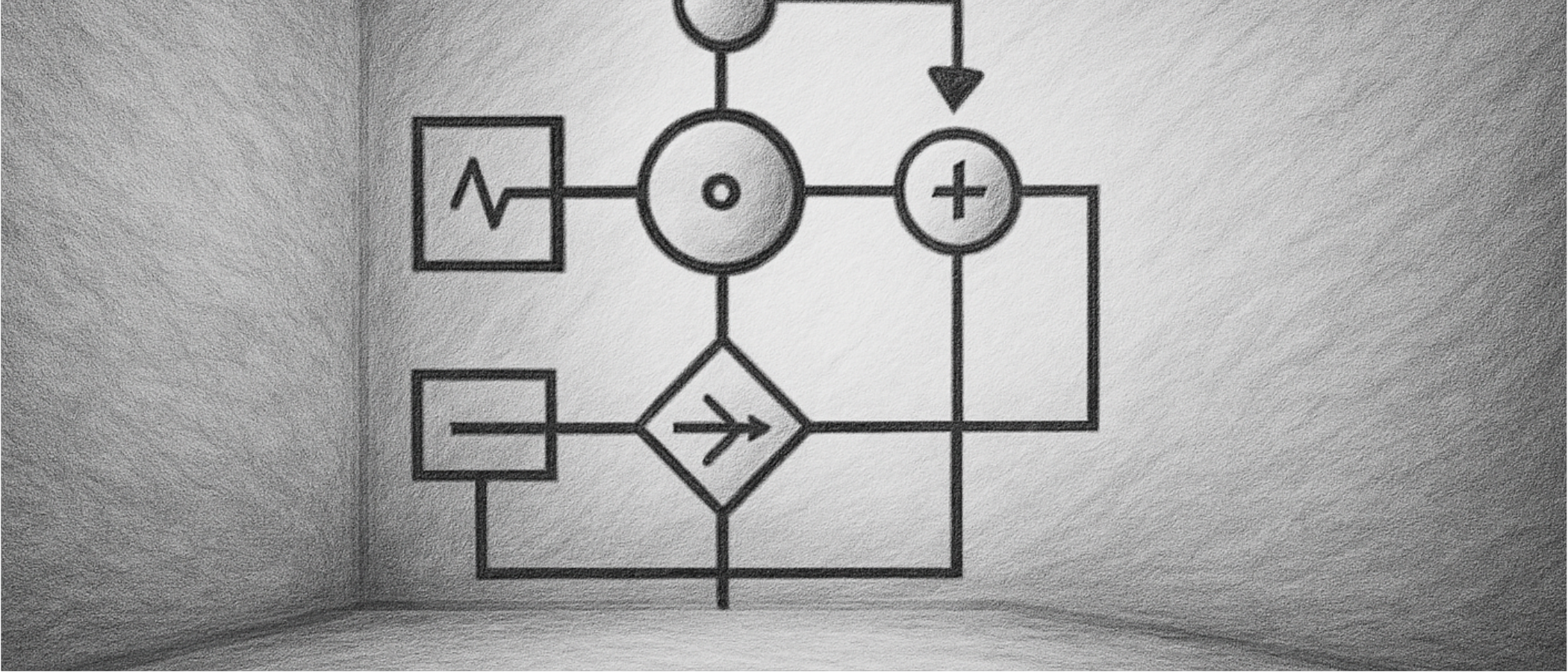
This is the input–reflection–creation loop. Each layer feeds the next. Skip any one of them and the circuit breaks.
Finally, block time for thinking the same way you'd block a meeting. It's not optional and it's not indulgent. It's the job. This is where you humble yourself. You are not above this, you probably spend too much time doing things you know are a waste, then you have the nerve to trivialise simple things like "reflecting". Which is essentially just sitting still and thinking.
Becoming the System
Here's where the shift starts.
Every intelligent system does three things. Gathers data (input), integrates it (reflection), and applies the new data (creation). That's how evolution built life, how the brain develops, how machine learning gets accurate. When you structure your own life this way, your growth stops being random.
Now add the last part of the cycle and we have the complete system: gather, integrate, apply, and finally adjust. Each one feeds the next. The more loops you complete, the more your intelligence compounds. Learning speeds up. Decision quality improves. The process starts feeling smoother, because the system is calibrating itself.
The adjustment is key, because that is where people have the edge over a machine. Our innate ability to adjust should not be underestimated.
At some point, you develop what you might call meta-awareness. You start noticing how you think, not just what you think. You catch patterns in your own reactions. You see the hidden assumptions underneath your decisions. You are basically beside yourself. Sitting next to the system.
That's when things change, because your system is no longer dependent on external input to grow. It starts generating its own feedback loops from ordinary life. It's become a super high-functioning organism.
Eventually the parts stop being separate. Work feeds learning, learning feeds judgment, judgment feeds better work. What started as a habit becomes an identity. You stop being someone who does these things and start being someone who simply is this way.
So What Do You Actually Do
Three things. (Always three.)
Schedule. Block one protected hour this week for uninterrupted learning. Phone in another room. No notifications. Go deep with a book, a thought, an idea you've been meaning to sit with. Make it unbreakable. Even one focused hour will build momentum that carries for days.
Map. Set up a single journal, log, or digital system where you track what you're learning, what you noticed, what surprised you. Review it weekly. Scan for connections. Adjust your routine to keep the loop alive.
Loop. Teach one insight to someone else. A post, a voice message, a conversation. Just the act of explaining it will surface angles you hadn't seen. Do it weekly. That's how the learner's lifestyle actually embeds itself.
The honest truth is that most people won't do this, because it looks like nothing. Sitting with a book, taking a walk, writing in a journal, or just thinking and reflecting. It doesn't look like productivity.
Remember; that's the whole point. We aren't in the productive economy. Everyone uses claude, gpt or gemini to maximise output, you aren't f**king special when it comes to that. You need to wake up and realise we are in the knowledge economy.
The key is thinking better, reflect more and combine your ideas with other ones.
Processes will always change, your energy will constantly go through up and down cycles, productivity is constantly fleeting.
But wisdom will always compound. 🌈