Effortless Achievement
tony g · March 14, 2026
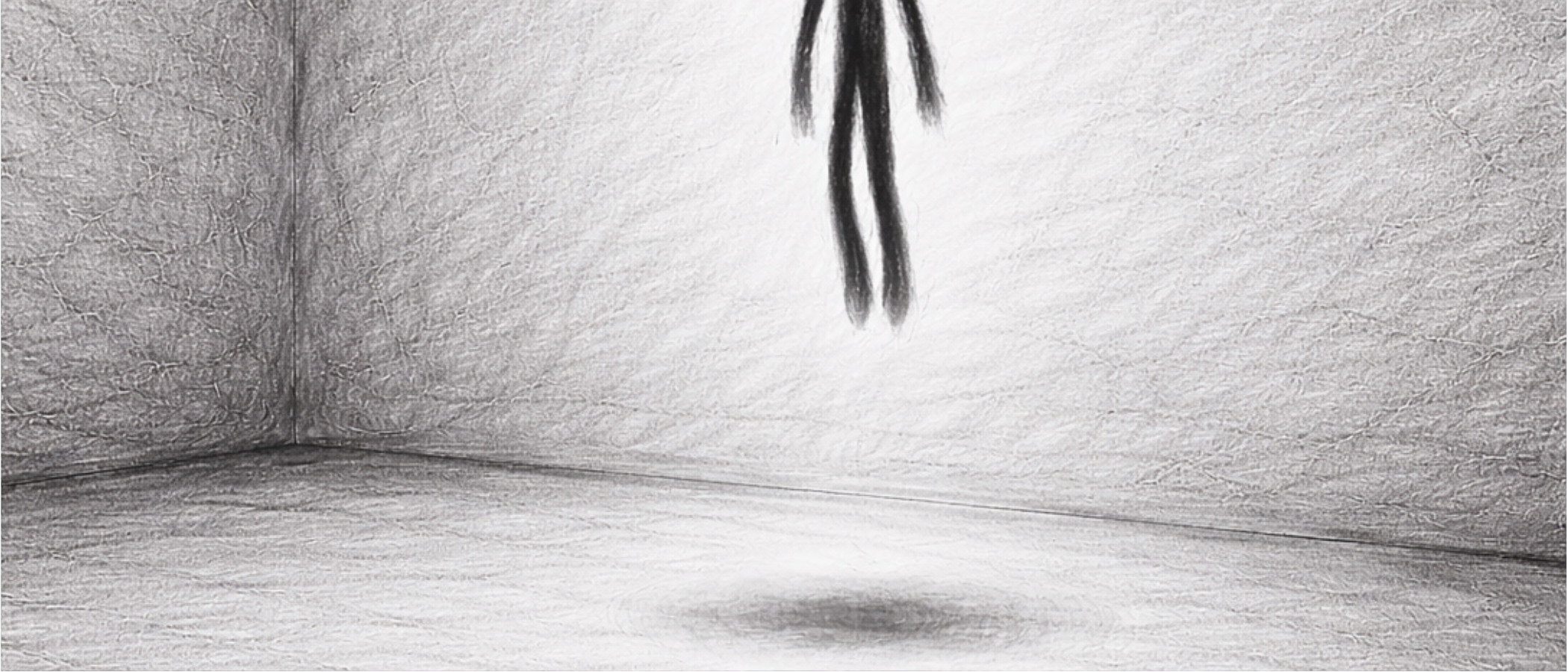
Putting in more effort is rarely the best path forward. The moment you begin to relax is when it all comes together.
Don't stop. Put in more effort, keep going, keep grinding. Right?
There's a branch of physics called fluid dynamics. It studies how liquids and gases move, and it found two fundamental patterns. Laminar flow, which is smooth and orderly, moving in clean parallel, almost no wasted energy. And turbulent flow, which is chaotic, still moving forward, usually going nowhere useful (the "grind").
The interesting part isn't the fluid. It's the conditions. Push water too hard, you get turbulence. Add some obstacles, turbulence. Fight harder, and again, turbulence. Let it flow naturally through a clear path, and you get laminar. The same substance. Still just water, but completely different behaviour depending on what you do to it. Riveting.
Once you see this, you start noticing it everywhere. The world around you is full of traffic in energy, including inside your own head.
What We Ignore
Most people assume that the harder you push, the faster things move. Physics disagrees, but more importantly, I disagree.
Excessive force doesn't create momentum. It creates churns, or pockets of resistance that slow everything down. The same thing happens psychologically. The more you grip, the more friction you generate. The more you try to force an outcome, the more internal resistance appears. Your mind isn't being lazy. It's just in a state of turbulence.
Pressure rarely comes from a task. It comes from the chaos you create while pursuing it.
Effortless achievement isn't about doing less. It's about removing that generated resistance you create which makes everything feel harder. The effort is still there, and always is but there's just nothing fighting it from the inside.
What Makes Your Life Harder
Psychological turbulence usually builds from three places, and they tend to show up together.
The first is mental overactivity (surprise, surprise). This bracket includes your mind simulating conversations that haven't happened, or preparing for problems that don't exist. You run the same loop again without any new information. It feels like productivity. Although it's just noise with good PR. Each unnecessary cycle adds friction to your decisions, you burn fuel, fuel needed for actual work.
The second is excessive emotional investment. When you attach significance to outcomes, every step starts feeling heavier than it needs to. Success starts to feel like survival and failure starts to feel like a verdict. The stakes are not that high, but your nervous system doesn't know that, because you keep telling it otherwise. Trust me, you aren't that important.
The third is action from fear. Avoiding the path toward something meaningful, to guard from imagined feared consequences. Decisions feel forced and reactive. You're not building on anything. You're just trying to outrun the worst case scenario you invented in your head.
So what happens? Well, all three can land at once. The whole inner system becomes a rapid river crashing against itself. The workload hasn't changed. The internal conditions have. Which is why some days the same tasks feel ten times heavier than others.
Your goal is rarely as difficult as it seems. The issue is that the mind is in a state that makes simple things feel that way.
Ease ≠ Apathy
This is the part people get wrong.
Being at ease, or feeling effortless does not mean the task is small or (even worse) that you don't care. Being at ease simply means that you've stopped fighting yourself. Tension feels like commitment. Anxiety feels like effort. Neither of them are. Anyone who's ever been genuinely in flow knows that performance peaks when the mind goes quiet, not when it cranks up (i.e. when it's "grinding" ❌).
Musicians enter flow when they stop overcontrolling their instruments. Athletes perform best when they trust the training instead of trying to analyse their every move. Entrepreneurs make their clearest decisions when the mind stops sprinting ten steps ahead of the moment. That's just presence ✅.
Tension is what converts laminar flow into turbulence. It compresses your attention, narrows your perception, and adds emotional significance to things that don't deserve it. You push because you're tense. Pushing increases the tension. Tension amplifies the importance. So you push more. Vicious circle, it sustains itself. The wild part? It's entirely optional.
The antidote is simply being present. When you're not thinking about some future simulation, or replaying that conversation in your head over and over, your actions straighten out. What felt overwhelming becomes manageable, because you're dealing with what's real instead of the mental model you built around it.
Let Go (not what you think)
Letting go doesn't mean you stop caring. It means you stop making your identity contingent on the result. It means you bring yourself back to the current moment. You're physically here, so now it's time to mentally arrive.
When you believe your worth depends on whether "this thing" succeeds, failure becomes existential rather than informational. If a failed attempt is a verdict on who you are, that pressure creates turbulence. When you remove it... it's just an attempt. Useful. Survivable. Sometimes even interesting or even pointless.
A fixated mind navigates a narrow map. A relaxed one sees the full terrain, including the unexpected routes that turn out to be better than the original plan. This isn't optimism or positivity. No. It's just what happens when the perception stops being distorted by pressure.
So what do you actually do
Three things (more homework).
Lighten. When the moment starts to feel heavier than it should, that's your signal. Just stop. Find where you're holding this tension. Slow your breath. Drop your shoulders. Bring your attention back to what's actually in front of you. Keep it light and be kind to yourself in that moment. Seems small, but it might be just enough to pull you out of the spiral before turbulence drags you.
Level. Once the initial emotional charge eases, ask yourself a question. A simple one. "What's actually happening right now?" or "What's the real next step here?". Not; "what's going to go wrong?" or "how do I look doing this?" Come back to the situation. Calm it down. What does this moment actually need? That question cuts through your invented story and brings you back to reality. Now you're present and the moment is more manageable.
Lean. Take the next action without force (this one is important). Act but don't aim to prove something. Don't drive yourself with anxiety about falling behind. Take action that makes sense right now, with a steady hand, or with a slight lean. Leaning is how you build forward motion without reintroducing turbulence. One step leans into the next. The mind stays quiet enough to notice what's needed. Things start to move on their own.
This is a loop. Run it whenever you feel yourself starting to drift out of alignment. Not just in the big moments. The small ones are where turbulence usually starts, and where it's easiest to stop.
Lighten the mood, level yourself in the present moment and just lean into the next one. How about that for a tl;dr.
Start floating and cruise forward. 🌈